
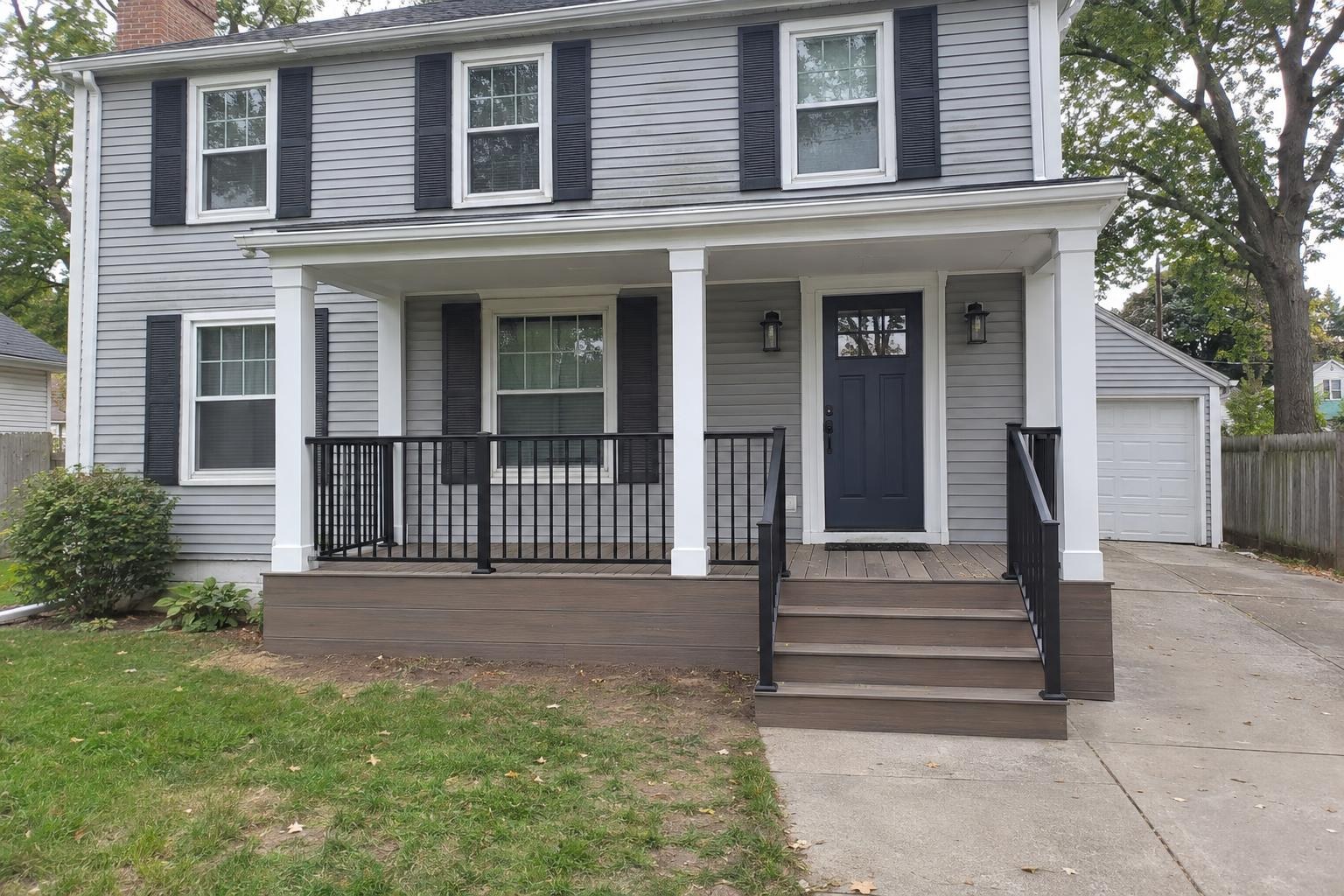
Buffalo Grove sits on clay-heavy soil, like most of Lake and Cook County. Clay holds water, then it swells. It dries out in a hot July and shrinks back down. A deck footing that isn't poured deep enough will move with that cycle, year after year, until you've got a post that's noticeably out of level or a set of stairs that's pulled away from the landing. That's the first thing a real deck builder is thinking about before they ever talk railing style or decking color.
The ground sets the footing depth, not the deck design
Illinois frost depth in this area runs around 42 inches. Footings have to go below that line or the ground will heave them in winter. A contractor who tells you "we usually just do 18 inches, that's plenty" is either guessing or cutting corners, and either way you're the one who finds out in three years when a post shifts. Ask how deep the footings will be poured and ask them to say a number, not a shrug.
Older streets near Lake-Cook Road or in the neighborhoods built through the 1960s and 70s sometimes have clay fill over what used to be farmland, plus whatever a previous owner buried out back decades ago, an old patio slab, a dry well, who knows. A newer subdivision off Weiland or Aptakisic tends to have more consistent, engineered fill, which actually makes footing work more predictable. Either way, a decent crew digs a test hole before they commit to a footing layout, not after.
Permits aren't optional, and a good builder won't pretend otherwise
Buffalo Grove requires a permit for deck construction, and the village inspects footings before they're poured over, then again at framing before decking goes down, and a final inspection once railing and stairs are complete. If a contractor says they can "skip the permit to save time," that's not saving you anything. It's skipping the one process that catches an undersized footing or an improperly attached ledger board before it's buried under decking for the next twenty years. If your lot backs up to a detention area or you're near a recorded easement, which isn't unusual in this area, setbacks can matter too, and a legitimate builder checks that before pouring concrete, not after the village red-tags the job.
A lot of subdivisions here also have an HOA with its own deck guidelines on height, railing style, or stain color. That's a separate approval from the village permit. Ask upfront whether your builder is used to pulling both, because missing the HOA step is a common way projects get delayed mid-build.
What to ask about the ledger board and the fasteners
Most deck failures that make the news aren't the decking boards, they're the ledger board, the piece that bolts the deck to the house and carries a big share of the load. It needs to be lag-bolted or through-bolted into the house framing, not nailed, and it needs flashing behind it so rain doesn't sit between the ledger and the siding all winter. Ask directly: "are you using through-bolts or structural screws on the ledger, and what's your flashing detail?" A builder who's done this for years will answer in one sentence. One who hesitates probably hasn't thought about it.
Joist hangers matter the same way. Galvanized or stainless-rated hangers and nails are required with pressure-treated lumber because the chemicals in modern treated wood corrode plain steel faster than people expect. If a crew is using whatever hardware was left over from a different job, that's a problem you won't see until the hangers are rusted through.
What separates a real bid from a lowball one
- A real bid specifies lumber species or composite brand, board spacing, joist spacing (16 inches on center is standard, some spans need 12), and footing depth. A lowball bid says "deck install, 300 sq ft" and a price.
- A real bid includes the permit fee and the time to get it. A lowball bid doesn't mention a permit at all.
- A real bid tells you when you can walk on it and when you can put furniture on it. Pressure-treated lumber usually needs weeks to dry before staining; composite can be used right away but the fasteners and hidden clips still need to be installed correctly or boards will "ripple" by the second summer.
- A real bid has a timeline that accounts for Illinois weather. Spring here is wet, several inches of rain across April and May isn't unusual, and that slows down footing pours and concrete cure time. A contractor who promises a two-day install in late April without mentioning weather as a variable either hasn't built here long or isn't being straight with you.
Red flags worth walking away from
Cash only, no written contract. A price that's dramatically lower than two other bids for the same square footage. Pressure to sign same-day. No mention of permits, unprompted. Can't name the lumber grade or composite brand they'd use. Insurance they can't produce proof of on request, not just a verbal "oh yeah we're covered." None of these alone means a contractor is a fraud, but together they're the pattern that shows up again and again in the bad jobs that get called in as repairs two or three years later, usually a sagging ledger, a railing that was never through-bolted, or a set of stairs sitting on footings that were never poured below frost line at all.
None of this means you need the most expensive bid in the stack. It means you need a bid you can actually ask follow-up questions about, from someone who answers them without reaching for a brochure. We do deck installation, repair, resurfacing, and everything in between at Evercrest Deck Contractors, and we're happy to walk through footing depth, material choice, or the permit process with you before you've committed to anything.